Showing posts with label facebook. Show all posts

Monday, June 11, 2012


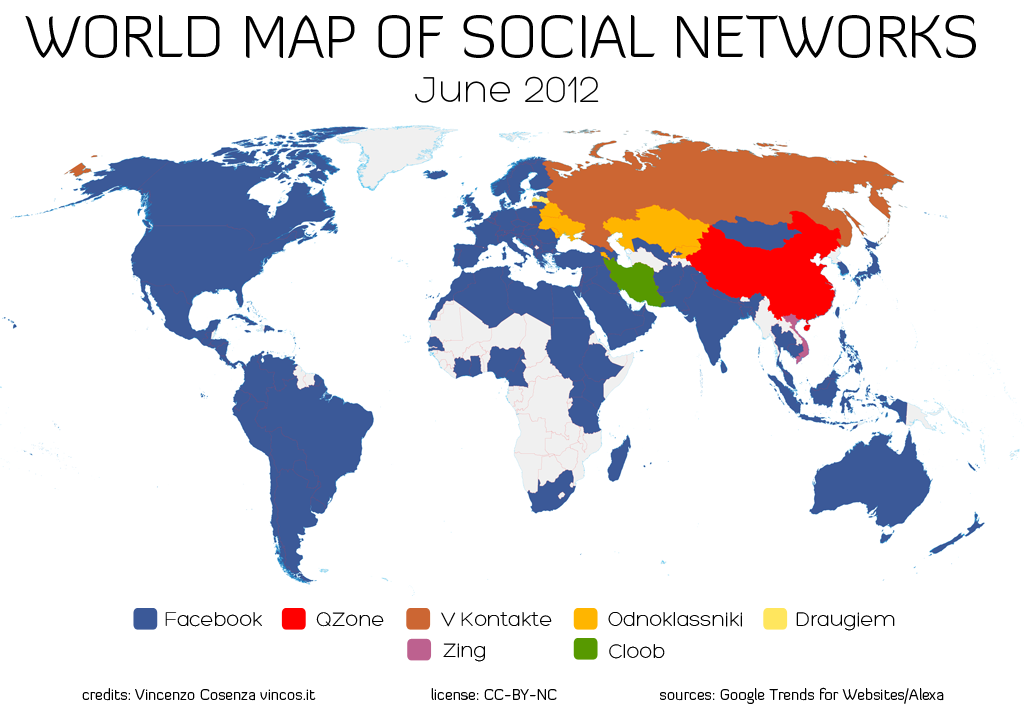
Facebook is eating the world, except for China and Russia: World map of social networks


Twice a year (in June and in December), social media strategist Vincenzo Cosenza updates his ‘world map of social networks’, in which he shows what the most popular social network is in now 137 countries worldwide – at least according to a combination of Alexa and Google Trends for Websites traffic data.
The edition for June 2012 was published by Cosenza earlier this afternoon, and it shows just how dominant Facebook has become in almost all of the world.
Funny caveat: Google+ stats are not displayed by Google Trends for Websites.
According to the traffic data examined by Cosenza, Facebook is numero uno in 126 out of the 137 countries that were analyzed. Europe is the largest continent on Facebook with 232 million users, while North America has 222 million and the whole of Asia boasts 219 million users (source: Facebook Ads Platform).
It’s only when you look at this animated gif that shows how the map colors have changed over the years that you get a sense of how Facebook steamrolled its competitors in most countries around the world.
The hold-outs aren’t a huge surprise, but for the record:
- VKontakte and Odnoklassniki remain strong in Russian-speaking countries
- Tencent’s QZone is still king of the hill in China
- Vietnam’s most popular social network is Zing
- People in Iran seemingly prefer Cloob over Facebook
- Drauglem is the top dog in Latvia
And here’s a table that shows who is the second most dominant social networks in various European countries, the United States, Brazil, China, India, Russia, the United Kingdom, Australia, Canada and Japan. Looks like LinkedIn, Badoo and Twitter are currently duking it out for the #2 spot, with only a few exceptions.


o
Share/Bookmark

Friday, May 18, 2012


India Set to Overtake US as Facebook’s Largest Market


India is set to overtake the U.S. as the world’s largest Facebook market by number of users as early as 2015, according to social media analysts, driven by growing internet penetration and high rates of growth in mobile connections.

“India could overtake the United States in the next three years. Last year, Facebook users in India doubled. Growth will be driven by mobile internet users in second- and third-tier cities,” Shalini Verma, Principal Research Analyst at Gartner, noting that the U.S. market is saturated in terms of user numbers.
As Facebook’s third largest market, India is home to over 45 million users, behind Brazil and the United States with 47 and 157 million users, respectively, according to the latest data from Facebook's advertising platform.
With approximately 120 million internet users, India’s internet population is forecast to grow threefold to almost 400 million users by the end of 2015 to mid-2016, according to Suhale Kapoor, Executive Vice President at analytics and market research company AbsolutData. Kapoor says by that time, India will have surpassed the U.S. in terms of Facebook users.
With smartphone prices declining and data rates among the cheapest in the world, Kapoor believes the mobile platform will drive the growth in Facebook’s penetration in India.
Kapoor says smartphones in India cost as little as 5,000 rupees ($92) as prices have been falling steadily over the last 3-4 years, making it more affordable for middle class consumers. “There are daily data plans priced at 10-20 rupees (18-37 cents), this will be another driver of (Facebook) adoption, especially among students.” 
Kapoor adds that India’s young demographic base means that there will also be an increasing number of Indian teenagers reaching “social media age”, or the minimum age required for signing up on social networks. In order to be eligible to sign up for Facebook, for example, a user must be 13 years of age.
Even though just 11 percent or 125 million Indians speak English, according to the most recent census data, Kapoor and Verma say language won’t be a hurdle for the company’s expansion.
“People in India write in a mix of both English and Hindi,” Verma said. Many Indians also write Hindi words using the roman script, rather than the traditional Devanagari script.
But Facebook is also trying to catch those who would like to use their local language to communicate. Last month, it announced the launch of the “Facebook for Every Phone” mobile application in seven local Indian languages — Gujarati, Tamil, Malayalam, Kannada, Punjabi, Bengali and Marathi, in addition to Hindi, which became available last year.
 
Not a Big Revenue Market

But for investors hoping to bet on this big growth in users, Prashant Agrawal, a principal in Boston Consulting Group in Mumbai says India won’t be able to match the U.S. in terms of revenue, given the country's much smaller advertising market.
Annual advertising spending in India is just $255 million, compared with around $158.9 billion for the U.S.
Kunal Sangoi analyst at Edelweiss Securities also points out that Internet advertising makes up just 3 percent of India’s ad market, compared to 17 percent in the U.S.
“Our discussions with industry players suggest Facebook earned revenues of $5-10 million from India in the fiscal year ending in March 31, 2011,” Sangoi said.
In some ways, India epitomizes the challenge facing Facebook across Asia, says Thomas Crampton, Asia-Pacific director of a unit of Ogilvy & Mather.
Facebook's average revenue per person in Asia is just $1.79, compared to $9.51 in North America, says Crampton. “The future for Facebook is finding a way to monetize all these people in terms of their revenue base.” 


o
Share/Bookmark

Thursday, May 17, 2012


Swedes' pension hopes tied to Facebook IPO


Close to 3 million Swedes will be watching the upcoming stock market debut of Facebook with added interest after news emerged on Thursday that a major Swedish pension fund planned to invest in the social networking site's initial public offering.


The Seventh AP Fund AP7 (Sjunde AP-fonden – AP7) plans to be among the initial investors in the highly anticipated public offering of Facebook.

AP7's participation in the Facebook IPO means that 2.7 million Swedes will be indirect owners of stock in the popular social networking site, which boasts nearly 1 billion users worldwide.


At the same time, a survey by Swedish online brokerage firm
Avanza has revealed that around 7 percent of Swedes are considering buying Facebook stock directly as individual investors.

AP7, the default pension fund for Swedes who opt out of making an active investment choice for their public pensions, plans to invest around 400 million kronor ($56 billion) in Facebook, when it gets listed on the Nasdaq stock exchange in New York later this week.


That means that each AP7 pension saver will end up having about 150 kronor of their pension savings invested in the internet company, according to the Dagens Nyheter (DN) newspaper.


Facebook hopes to raise about $15 billion by releasing more than 400 million shares in the company with a price range of $34-$38 per share, according to the Reuters news agency.


Some analysts have projected that Facebook's IPO could end up valuing the company at more than $100 billion, but many remain skeptical about the valuation of the company, which needs to see a drastic rise in advertising revenue in order to live up the high expectations surrounding the public offering.


One of the skeptics is Avanza economist Claes Hemberg, who is concerned that interest in Facebook stock is so high among Swedes.


"There are a lot of young people who risk making their first and worst deal of all time," he stated.


o
Share/Bookmark


4 things you need to know about Facebook's IPO


The community, which was initially the domain of Ivy League college students, is on the verge of becoming a publicly traded company when it floats on the stock market, an event likely to take place Friday.
That’s great news for investors looking to pick up a piece of the company. With billions of dollars on the line and more than 900 million active community members, Facebook isn’t just a casual hook-up site any more.
There’s a lot to say about how the IPO will affect community members, both among those looking to pick up a few shares in the company and those who use Facebook to share updates and photos with their friends.

You have a chance to own a part of the community
The lure of owning a bit of Facebook, no matter how small, is enticing to many. The obvious is the promise of financial returns from the world’s largest social network, though it’s not entirely clear exactly what the company’s business model will be. It also might be a vanity thing for some, though being a Facebook shareholder will let you vote at the company’s annual general meeting.
Facebook reportedly plans to sell shares at a maximum of $45, meaning it could raise up to $18.4 billion on Friday. It’s likely that it’ll cost you more than that if you want to snap up some shares tomorrow as investors who grab stock at the IPO price look to make a quick buck on their investment. That said, being able to brag about how you own a bit of Facebook to your friends would be kinda neat.
(Note: Please do not take any of this as financial advice. Consult your accountant and think carefully before ploughing your hard-earned cash into any stock.)
Oh, and if you’re an amateur financial analyst, you can take a stab at guessing the closing share price after Facebook’s first day on the market thanks to a fun website.

Facebook will try to make more money from you

One of the big clouds hanging over Facebook’s head as the company ramps up is how to generate more revenue. The company makes around $5 per year per user—far less than the likes of Google and Netflix.
Investors will be looking for Facebook to bump up its revenue and justify its lofty valuation. There are two ways to do that: get more users or find new ways to make bank off the ones they have.
The first of those is tricky. Convincing holdouts and the three-quarters of American seniors not already on Facebook to sign up, and finally breaking into the Chinese market would undoubtedly boost those user metrics. Yet those are difficult propositions and Facebook may be more likely to try and make more cash off its existing community.
As it stands, Facebook makes the bulk of its revenue from advertising and revenue share agreements with the likes of Zynga. However, it’s playing around with new ways of making money, such as the highlighted posts feature it was testing in New Zealand last week.
It seems more ads will seep into your News Feeds, with sponsored stories and endorsements from friends. The question is, how much can Facebook disrupt the current, relatively pure experience, before it creates an opportunity for a competitor? (And even if it does, how will that competitor make money?)
The company noted in its S-1 filing with the Securities and Exchange Commisison that, “The loss of advertisers, or reduction in spending by advertisers with Facebook, could seriously harm our business.” Losing around $10 million in General Motors ad spending Wednesday isn’t helping.

Facebook’s mobile focus

For everyday Facebook users, the most significant thing that’s likely to change is the mobile experience.
Facebook’s mobile apps are slow and clunky. However, with much of our Facebook activity moving away from the Web and onto mobile phones, mobile is an issue the company admits it needs to address. Making money off mobile is a problem too.
Social ads are an important focus for Facebook here. Your location data might be used to offer more personalized ads too. Normal display ads don’t work as well, due to phones’ smaller screens. Facebook might also turn to its new App Center to juice up its mobile revenue, so expect the company to start pushing that a little more aggressively.
Zuckerberg still rules the roost
As mentioned above, you will have the right to vote in corporate matters if you can get your hands on some Facebook stock. But your vote may not count for much.
Thanks to some deals struck through Facebook’s various rounds of financing, CEO Mark Zuckerberg holds over half of the voting power within Facebook. That’s despite his owning around under a third of the company after the IPO.
In other words, it’s still Zuck’s house and if he wants to rearrange the board of directors, buy another company (like Instagram), or install a Facebook office on the moon, he can do so. If he ever wants to start charging you to use Facebook, he can do that too—though it’s unlikely.
Not that much changes here, in all honesty. Though if you’ve pledged your allegiance to the state of Facebook, it’s worth noting that you’re living in a (so far) benevolent despotism.
Down the road, Facebook might offer new features like a fully fledged search engine, though that’s not directly tied to the IPO. For now, expect better ways to access Facebook through mobile and Facebook coming at your wallet.


o
Share/Bookmark


This site lets you challenge the pundits and predict Facebook’s IPO closing price


Facebook’s upcoming IPO is dominating tech investors’ discussions and thoughts, but you can get involved in the evident too, even if you’re not one of those ready to put cash on the table for a slice of the global social network sensation.
Facebookipodayclosingprice.com is a site that’s been pulled together — in a fantasy football-style — to allow experts and ordinary punters to mix together and place bets on Facebook’s share price at the closing bell (though, ironically, sign-in to the site is via Twitter.)


o
Share/Bookmark

Tuesday, May 15, 2012


Poll: Half of Americans call Facebook a fad
 
Half of Americans think Facebook is a passing fad, according to the results of a new Associated Press-CNBC poll. And, in the run-up to the social network's initial public offering of stock, half of Americans also say the social network's expected asking price is too high.
The company Mark Zuckerberg created as a Harvard student eight years ago is preparing for what looks to be the biggest Internet IPO ever. Expected later this week, Facebook's Wall Street debut could value the company at $100 billion, making it worth more than Disney, Ford and Kraft Foods.
That's testament to the impressive numbers Facebook has posted in its relatively brief history. More than 40 percent of American adults log in to the site —to share news, personal observations, photos and more— at least once a week. In all, some 900 million people around the world are users. Facebook's revenue grew from $777 million in 2009 to $3.7 billion last year. And in the first quarter of 2012 it was more than $1 billion.
Just a third of those surveyed think the company's expected value is appropriate, while 50 percent say it is too high. Those who invest in the stock market are more likely to see shares as overvalued, 58 percent said so. About 3 in 10 investors say the expected value of shares is fair. Facebook on Tuesday lifted the expected price for its shares to $34 to $38 apiece from $28 to $35 each.
But price worries won't necessarily stop would-be investors. Half the people surveyed say they think Facebook is a good bet, while 31 percent do not. The rest aren't sure. Americans who invest in stocks roughly agree, although investors who are more "active" — those who have changed their holdings in the past month —are more negative. Nearly 40 percent say Facebook would not be a good investment.
Young adults, a majority of whom log on to Facebook daily, are more willing to dance to their hoodie-wearing piper, 28-year-old CEO Mark Zuckerberg. Among Zuckerberg's peers, adults under age 35, 59 percent say Facebook is a good bet. Compare that to the views of senior citizens: Only 39 percent age 65 and over say Facebook shares are a good investment. Nearly half of Gen X'ers (ages 35-44) say the company is a good bet, as do 55 percent of middle-aged people.
Those under 35 are the generation most interested in Facebook's IPO because they've grown up immersed in the social network. They were the first users, logging in from their college dorm rooms. Later, Facebook expanded to allow high school-age and even younger students to sign up. It's become an integral part of their lives, giving them a launching pad to spread the news of life's major developments through posts and pictures.
Conversely, it's the rare senior citizen on Facebook: Just 21 percent have an account. Half of baby boomers — the generation born in the years after World War II — have one. But most of the 56 percent of the country that's on Facebook is young — two-thirds of Gen X'ers and a staggering 81 percent of people 18-35 use the social networking site.
Young people aren't just connected. They are constantly tethered to smartphones, tablets and notebook computers. Even with the rise of alternative social networks like Twitter and Google Plus, 55 percent of Zuckerberg's peers go on Facebook every day. A third log on several times a day. Despite the intensity of their use, a narrow majority of young adults predict Facebook's appeal will fade down the road (51 percent), fewer think it will stick around as a service (44 percent).
The public overall is similarly divided on the company's future. Just under half of adults (46 percent) predict a short timeline for Facebook, while 43 percent say it has staying power.
Young people are more aware of Zuckerberg and have more positive views of the CEO, who celebrated his 28th birthday on Monday. Overall, one in five Americans say they've never heard of him, 30 percent don't have an opinion and 14 percent plain don't like him. Only about a third have a good impression of the CEO, who has alienated some with Facebook's ever-changing approach to user privacy.
But 46 percent of people under 35 like him. And a scant 4 percent of those younger adults say they've never heard of him.
The privacy issue is a stinger. Three of every five Facebook users say they have little or no faith that the company will protect their personal information. Only 13 percent trust Facebook to guard their data, and only 12 percent would feel safe making purchases through the site. Even Facebook's most dedicated users are wary — half of those who use the site daily say they wouldn't feel safe buying things on the network.
As for how Facebook makes most of its money —selling ads— 57 percent of users say they never click on them or on Facebook's sponsored content. About another quarter say they rarely do.
Despite user discontent about privacy, Facebook and Zuckerberg have connected with many Americans. The survey suggests that his reputation and youth seem more like assets than liabilities. For those who have heard of the CEO, two-thirds are at least somewhat confident in his ability to run a large public company. Twenty-two percent doubt he can handle the leadership role. As for the social network he created, 51 percent of Americans clicked "Like."
The Associated Press-CNBC Poll was conducted May 3-7, 2012 by GfK Roper Public Affairs and Corporate Communications. It involved landline and cell phone interviews with 1,004 adults nationwide and has a margin of sampling error of plus or minus 3.9 percentage points.


o
Share/Bookmark

Saturday, April 28, 2012


Street closed after 14th birthday party goes viral


A 14-year-old boy has 50,000 guests signed up to attend his birthday party near the central town of Clermont-Ferrand after his event page went viral on Facebook.


"I’m going to lock up the house. There’ll be no party," the father of a 14-year-old Benjamin said after news of the party started to spread.
"My son is not organising a party, I want that to be perfectly clear."
Benjamin wanted to organise a party with a few friends at his grandmother’s home in the village of Chamalières near Clermont-Ferrand to celebrate his birthday, French public radio France Info reports. One of his friends organised a secret event on facebook, which allows guests to invite up to sixty other facebook friends. 
The secret event however went viral and facebook users started relaying the invitation until 50,000 had signed up to attend Benjamin’s party on May 11th. 
Benjamin’s father has cancelled the party and lodged a complaint for impersonation.
The police have taken the Facebook invitation seriously and say they are considering blocking the street where Benjamin’s grandmother lives. They are also considering deploying a police unit on the evening of the cancelled party. 


o
Share/Bookmark

Saturday, April 7, 2012


When the cops subpoena your Facebook information, here's what Facebook sends the cops


This week's Boston Phoenix cover story -- Hunting the Craigslist Killer: An Untold Detective Story from the Digital Frontier -- would not have been possible without access to a huge trove of case files released by the Boston Police Department. Many of those documents have never been made public -- until now. As a kind of online appendix to the article, we're publishing over a dozen documents from the file, ranging from transcripts of interviews to the subpoenas that investigators obtained from the tech companies that helped them track the killer's digital fingerprints. We've also published the crime scene photos and uploaded recordings made by investigators as they interviewed the killer, Philip Markoff, and others involved in the case.
One of the most fascinating documents we came across was the BPD's subpoena of Philip Markoff's Facebook information. It's interesting for a number of reasons -- for one thing, Facebook has been pretty tight-lipped about the subpoena process, even refusing to acknowledge how many subpoenas they've served. Social-networking data is a contested part of a complicated legal ecosystem -- in some cases, courts have found that such data is protected by the Stored Communications Act.
In fact, we'd never seen an executed Facebook subpoena before -- but here we have one, including the forms that Boston Police filed to obtain the information, and the printed (on paper!) response that Facebook sent back, which includes text printouts of Markoff's wall posts, photos he uploaded as well as photos he was tagged in, a comprehensive list of friends with their Facebook IDs (which we've redacted), and a long table of login and IP data. 
This document was publicly released by Boston Police as part of the case file. In other case documents, the police have clearly redacted sensitive information. And while the police were evidently comfortable releasing Markoff's unredacted Facebook subpoena, we weren't. Markoff may be dead, but the very-much-alive friends in his friend list were not subpoenaed, and yet their full names and Facebook ID's were part of the document. So we took the additional step of redacting as much identifying information as we could -- knowing that any redaction we performed would be imperfect, but believing that there's a strong argument for distributing this, not only for its value in illustrating the Markoff case, but as a rare window into the shadowy process by which Facebook deals with law enforcement. 
As far as we can tell, nobody's ever seen what one of these looks like -- and we're hoping the social media, law, and privacy experts out there can glean insight from it:  


o
Share/Bookmark

Sunday, March 4, 2012


Tajikistan Shuts Down Facebook


Tajik authorities have blocked access to several web sites, including, among others, news web sites critical to the president Emomali Rakhmon and the popular social network Facebook, Tajik news agency Asia Plus reported on Saturday.
According to the Asia Plus, Tajik Internet providers received both letters and verbal notices from the country’s Telecommunications Authority to shut down several web sites “over the emerged necessity.”
The Internet providers have different lists of the banned web sites, but all of them include Facebook.com, Zvezda.ru, Tjknews.com and Maxala.org, the agency said.
Zvezda.ru, an analytical web site on politics, was shut down on Friday evening, soon after publishing an article titled “Tajikistan ahead of Revolution” that analyzes Rakhmon’s growing autocratic moves that according to the author of the article will bring the country to the mass unrest.
Facebook, which is used by protesters in Arab countries and in Russia to coordinate public rallies, was also blocked.
Tajik communication regulator is not available for comments.


o
Share/Bookmark

Tuesday, February 28, 2012


Facebook Id

Cards


If Facebook hasn't taken over your life entirely, here's the ultimate way to completely immerse yourself into social media. 


 The FB Bureau (yes, that exists) is performing a test trial with Facebook personal identification cards. Basically it's a way for people to be able to do an internet background check with just a simple scan. The internet will soon own all of us. 


 The design was created by Tobias Leingruber and is already set to be distributed Supermarkt in Berlin, Germany starting March 2, 2012.


o
Share/Bookmark

Tuesday, February 21, 2012


MUST READ


New ways Facebook can cost you a job
 
A new study shows that an employee’s Facebook profile can accurately predict his or her job performance.
Now before you frantically untag all those shots of you doing keg stands and ice luges, keep in mind that it’s much more complicated than simply having a sparkling non-alcoholic profile.
Researchers from Northern Illinois University, the University of Evansville, and Auburn University found correlations between personality indicators found on Facebook profiles and the results of performance evaluations conducted six months later.
For example, if you have lots of Facebook friends, that may indicates openness and extroversion, which can later manifest itself in the workplace.
Essentially, the study is a spin on the old “employers check your Facebook profile” story, except with less emphasis on party pics and more on overall character.
Or, as Don Kluemper, one of the authors of the story stated, “I don’t think a picture of someone holding a beer adversely affected them, but [a picture of you] being drunk in a ditch somewhere might be a negative.”
The study also raises some interesting questions about the potential legal complications of using Facebook profiles to evaluate job candidates:
“Although some employers might attempt to focus on job-related social networking information, there is also non-job-relevant information that could be used inappropriately for evaluating applicants, resulting in biased hiring decisions. During a job interview, an employer may avoid asking questions regarding race, religion, sexual preference, or marital status because of potential legal issues. However, such information may be posted or obvious in an SNW (social networking website).”
Nevertheless, applicants shouldn’t expect employers to stop using public information on the Web to evaluate candidates. So after excising all those pictures of you drunk in a ditch, better change your Timeline picture to one where you’re hanging out in Italy on that Study Abroad trip. Start friending everyone you’ve ever known since preschool to show what a charmer you are. And if Jackass 3D is on your list of liked movies—well, we’d tell you to change that, but it’s probably too late to help you.


o
Share/Bookmark

Friday, February 17, 2012


Department Of Homeland Security Tells Congress Why It's Monitoring Facebook, Twitter, Blogs

The House of Representatives' Subcommittee on Counterintelligence and Intelligence was not pleased


At a Congressional hearing this morning that veered into contentious arguments and cringe-worthy moments, the Department of Homeland Security (DHS) spilled the beans on their social media monitoring project.
DHS Chief Privacy Office Mary Ellen Callahan and Director of Operations Coordination and Planning Richard Chavez appeared to be deliberately stonewalling Congress on the depth, ubiquity, goals, and technical capabilities of the agency's social media surveillance. At other times, they appeared to be themselves unsure about their own project's ultimate goals and uses. But one thing is for sure: If you're the first person to tweet about a news story, or if you're a community activist who makes public Facebook posts--DHS will have your personal information.
The hearing, which was held by the Subcommittee on Counterintelligence and Intelligence headed by Rep. Patrick Meehan (R-PA), was highly unusual. Hacktivist collective Anonymous (or at least the @AnonyOps Twitter feed) sent a sympathizer to the visitor gallery to liveblog the proceedings under the #spyback hashtag.
Interactions between the DHS officials and representatives were often strained--both Chavez and Callahan were scolded and chastised by Representatives from both parties. Reps. Billy Long (R-MO), Meehan, Jackie Speier (D-CA), and Bennie Thompson (D-MS) all pointed out issues relating to what they variously saw as potential First Amendment violations, surveillance of citizens engaged in protected political speech, the fact that an outside contractor handles DHS' social media monitoring, DHS' seeming inability to separate news monitoring from disaster preparedness, and a massively unclear social media monitoring mandate on the DHS' part.
Video footage of the hearing has already been made available on YouTube, and the written testimony of both DHS experts has been made publicly available. Privacy watchdog group EPIC also filed a formal disclosure to Congress on the results of a FOIA lawsuit. DHS appears to have also stonewalled EPIC regarding their social media monitoring project. The results are staggering.
According to testimony, the Homeland Security Department has outsourced their own social media monitoring program to an outside contractor, defense giant General Dynamics. General Dynamics was the sole party to the original DHS contract, which was not offered to any outside parties--and Chavez was caught misleading the Committee about General Dyamics' sole status.
General Dynamics employees responsible for the DHS social media monitoring contract are required to attend a training course in DHS privacy practices several times a year. If General Dynamics employees misuse the personal information of journalists, public figures or the general public (to include Twitter or Facebook users) in any way, their punishment is restricted to additional training classes or dismissal from the project.
General Dynamics and the Department of Homeland Security are primarily engaging in keyword monitoring of social media. Callahan admitted in sworn testimony that the bulk of the keywords used by DHS were chosen as the result of being included in commercially available, off-the-shelf bulk packages. These bulk keyword packages were later customized according to DHS specifications.
The DHS, meanwhile, is truly interested in breaking news tweets. The Twitter handles, Facebook names and blog urls of first witnesses to news events (the attempted assassination of Gabrielle Giffords and a January 2012 bomb threat at an Austin, Texas, school were specifically cited) are being recorded. Homeland Security claims this information is only used to verify reports, and that dossiers are not being assembled on private citizens and that personally identifying information is regularly scrubbed from their servers.
Another worrying tendency is the fact that DHS appears to be keeping tabs on individual American citizens engaged in community activism and hot-button political issues. EPIC's evidence package to congress included FOIA-obtained data on community reaction to the housing of Guantanamo detainees in a Standish, MI prison. Against the DHS' own guidelines, the agency compiled a report titled Residents Voice Opposition Over Possible Plan to Bring Guantanamo Detainees to Local Prison-Standish MI. This report contained sentiment gathered from newspaper comment talkbacks, local blogs, Twitter posts, and publicly available Facebook posts--something expressly forbidden by the DHS' own policies. Chavez and Callahan claimed that the report was not disseminated and that privacy policies forbid similar things from occuring; nonetheless the report was made and not obtained by EPIC until they sued the DHS.
In testimony, the DHS representatives appeared unclear on what the collected data would actually be used for and which agencies would be using it. Hurricane Katrina was constantly bought up as a talking point, but Committee members were constantly blocked when they asked how Homeland Security would be using their social media findings. In addition, barriers preventing other government agencies from obtaining sentiment information from DHS on individual journalists or private citizens is extremely flimsy; when Rep. Chip Cravvack (R-MN) asked Chavez what he would do if, say, the Attorney General was asking for information, Chavez simply answered that his agency's mandate forbid him from doing that. While that answer is fine and good, it also infers that the DHS has not put proper inter-agency data security safeguards in place.
The hearing was less Big Brother then sloppy-kid-down-the-block... only with a big fat government contract. When numerous Committee members, including Long, questioned Chavez about the existence of similar social media monitoring projects at other government agencies, Chavez said he didn't know of any. Meanwhile, the Associated Press--in a major story--reported on Monday about the FBI putting out a contract for an almost identical project. As a mid-ranking official responsible for analysis operations, it is assumed that Chavez would have a vested interest in knowing what other government agencies were up to in the same field.
At other times, neither Chavez nor Callahan could answer to the Committee's satisfaction why a contractor was hired for the job nor why the federal government was misled on the duration of General Dynamics' social media monitoring contract.
According to testimony, a second, classified, Committee meeting on the subject of DHS social media monitoring was held on February 15 as well.


o
Share/Bookmark

Thursday, February 16, 2012


UPDATE


Facebook Mob calls death of Saudi journalist


Tens of thousands demand in a Facebook group, the punishment of the Saudi Arabian journalist Hamza Kashgari for allegedly insulting the Prophet Mohammed. You want to set an example and require the execution of 23-year-olds. Hardly anyone is opposed to hate, says, "Spiegel Online" on Thursday, and speaks of "digital lynch mob".

More than 25,000 people have been the Facebook group "The Saudi people want the punishment of Hamza Kashgari" joined. Most people who express themselves on the bulletin board of the group, calling for the death of 23-year-old journalist, for allegedly insulting the Prophet Mohammed in their opinion, and thus made the blasphemy guilty.
Kashgari had done ten days ago on Twitter Become a fictitious interview with the Prophet. In it, he had declared among other things, that he would not pray for Mohammed and hate certain things about him. He also wrote: ". On your birthday I will not bow before you and I do not kiss your hand," As a result, broke out in the Arabic-language Internet, a storm of anger and indignation at the tweets of the young man.
As Kashgari had recognized the danger emanating from the wrath of his brethren and sisters Faith, he fled to Malaysia. Apparently he wanted to fly from there to New Zealand. The authorities in Kuala Lumpur, however, soon took him firmly by the arrival and handed it off to Saudi Arabia, where he was wanted on a warrant in the interim.
The warrant for Kashgari was a clear violation of human rights and freedom of religion and freedom of speech, criticized Alev Korun, human rights spokesperson for the Greens. "Despite several warnings, with such a regime in which religious freedom is trampled every day with your feet, no common 'inter-religious Dialog Center 'build', was Foreign Minister Michael Spindelegger (ÖVP) made only appeasement and alleged, of course, you'll stand up for human rights in Saudi Arbaien.

ALSO SEE;

http://todaysdailypoop.blogspot.com/2012/02/normal-0-microsoftinternetexplorer4_8814.html

http://todaysdailypoop.blogspot.com/2012/02/saudi-sheikh-weeping-as-he-demands-that.html


o
Share/Bookmark

Wednesday, February 8, 2012


Facebook, Twitter more addictive than alcohol, tobacco


What’s more addicting than alcohol, tobacco, and coffee? Apparently, your desire to check social networks and to stay employed trumps all else, including urges to sleep and have sex.
People’s daily desires make it harder to resist the urge to check social networks like Facebook and Twitter for updates than to turn down an alcoholic drink or a cigarette. Sleep and sex were the two things people most longed for during the day, but the urges to keep on top of social networks and work were the hardest to resist.
Researchers from the University of Chicago Booth School of Business fitted 205 participants between the ages of 18 and 85 with BlackBerry devices in and around the German city of Würtzburg. Seven times a day over 14 hours for seven consecutive days, the participants were asked to message whether they were experiencing a desire at that moment or had experienced one within the last 30 minutes, what type it was, the strength of it, whether it conflicted with other desires, and whether they resisted or went along with it. 10,558 responses and 7,827 “desire episodes” were reported.
Alcohol, tobacco, and coffee prompted much lower levels of desire despite their addictive properties. Furthermore, people were relatively successful at resisting sports inclinations, sexual urges, and spending impulses. Resisting the desire to work (when it conflicts with other goals such as socializing or leisure activities), which was the hardest along with checking social networks, may be difficult because your job defines your identity, dictates many aspects of your life, and invokes penalties if important duties are not completed.
“Modern life is a welter of assorted desires marked by frequent conflict and resistance, the latter with uneven success,” Assistant Professor of Behavioral Science Wilhelm Hofmann told The Guardian. The fact sleep and leisure were the most problematic desires suggests “pervasive tension between natural inclinations to rest and relax and the multitude of work and other obligations. Desires for media may be comparatively harder to resist because of their high availability and also because it feels like it does not ‘cost much’ to engage in these activities, even though one wants to resist. With cigarettes and alcohol there are more costs – long-term as well as monetary – and the opportunity may not always be the right one. So, even though giving in to media desires is certainly less consequential, the frequent use may still ’steal’ a lot of people’s time.”
Throughout the day your willpower decreases. The researchers found that resisting a particular urge frequently or recently increases the chance of caving in the next time. This is because our constant efforts to resist temptation sap our willpower, which makes cravings even stronger.
The full results of the study will be published later this month in the journal Psychological Science.


o
Share/Bookmark

Friday, February 3, 2012


In China, Facebook Alternatives Thrive

Stocks of Country's Social Media Stars Rise Ahead of IPO


Anticipation over Facebook Inc.'s pending initial public offering has fueled a recent surge in stock prices of social media companies in China, where Facebook is blocked.
But while China's some 500 million Internet users have flocked to locally operated social networking sites in Facebook's absence, a lack of a dominant player in the sector makes it unlikely that a "Facebook of China" will appear anytime soon.

Shares of New York Stock Exchange-listed Renren Inc., a Facebook-like social-networking site, climbed 33% since market close on Thursday to $5.55 at the end of trading Tuesday following reports that Facebook expects to file for an IPO this week. Shares of Nasdaq-listed Sina Corp., which runs a popular Twitter-like microblogging service called Weibo, rose 13% to $70.27 in the same period.
The jump comes after shares of Chinese Internet companies have taken a hit after a number of high-value listings last year, in part sparked by investor concerns over fraud and corporate governance at some smaller Chinese firms.
"The 'Facebook' effect on Chinese Internet companies has already started," said Sina Chief Financial Officer Herman Yu. "A successful Facebook IPO may further heighten investor's interest in social media" and other potential leaders in related categories such as "open platform, social advertising and e-commerce."
Chinese social media companies, including Sina, Renren and Tencent Holdings Ltd., have thrived in terms of membership and activity over the past two years despite requirements from authorities to filter content based on censorship regulations.
But because none of the companies singularly have a presence as ubiquitous as Facebook's presence in the U.S., they don't have as much influence over the online advertising market.
Censorship requirements and other limitations on foreign companies in China have made it difficult for companies like Facebook to enter the market.
In 2010, Facebook Chief Executive Mark Zuckerberg said he was hoping to figure out the "right partnerships that we would need to do in China to succeed on our terms."
Mr. Zuckerberg said he was learning Chinese, and went to China to meet with executives at leading Internet companies in the country.
Indeed, Facebook's membership has become increasingly global, with 80% of its more than 800 million members located outside the U.S., making the relatively small representation from China in its network increasingly glaring.
But authorities have initiated campaigns to crack down on unwanted Internet content since then, and Facebook has not yet established operations here. Facebook and other sites, including Twitter Inc. and Google Inc.'s YouTube remain blocked by Web filtering technology, and at this point, analysts say the web services would have a hard time competing with established local rivals.
Gary Wang, chief executive of online video company Tudou Holdings Ltd., said he hopes the IPO will turn more attention to China.
"The market has been fixated on the Facebook IPO for so long," Mr. Wang said. "I hope their IPO will be done successfully and have a good post-IPO performance...the market will see there are plenty of great companies out there, including the Chinese Internet companies."
While China's social media sites are quickly growing, they still have far fewer members than Facebook. Sina's Weibo site had 227 million user accounts at the end of September, the latest number available. Renren had 137 million activated users as of September-end. Twitter has about 100 million active users.


o
Share/Bookmark

Thursday, January 12, 2012


To Catch a Beer Thief 


Circle K teams up with Silent Witness to look for minor criminals via Facebook


Have you ever scrolled through Facebook pages and, after discovering unflattering pictures of someone you know, briefly wondered why you associate with that person?
Thanks to Circle K, such observations could now lead to a cash reward—that is, if the people you know happen to have pulled off beer skips or cigarette raids.
Since August, the 625 Circle K stores in Arizona and Nevada have been occasionally posting surveillance-video stills from robberies and thefts to Facebook (facebook.com/CircleKAZCrimeBusters), in the hopes that someone might recognize the culprits and turn them in.
Tipsters can get up to $100 for their efforts.
"Social networking can be a great crime-fighting tool," said Carlos Estrada, loss-prevention manager of Circle K of Arizona and Nevada. "It used to be that someone would write a bad check, and we'd leave it under the (counter) glass, and they'd have to make good on it before they could buy anything else.
"Now, we put people's faces on Facebook."
The program, known as Circle K Crime Busters, is affiliated with the Phoenix-based nonprofit-organization Silent Witness (www.silentwitness.org) and other anonymous-tip lines such as 88-CRIME (88crime.org). Such partnerships are helping authorities solve cases that otherwise wouldn't get closed, said Darren Burch, coordinator of Silent Witness.
"It's community-based policing," said Burch, who is also a sergeant in the Phoenix Police Department. "We'll receive tips from anywhere, and we'll pay rewards based on any felony arrest and indictment. Last year, we solved more than 300 felony crimes."
Silent Witness has no official numbers on how successful Circle K Crime Busters has been, though the plan is to try to separate tips submitted through the program in order to get a better idea of its effectiveness, Burch said.
Estrada said at least four arrests have resulted from the tips, which can be submitted through an online tip site, over the phone or via text. It's meant to be anonymous, he said, which is why no comments are allowed on the Facebook page.
"I want them to have a safe conduit to report crime," Estrada said.
Most of the people in the posted stills are suspected of misdemeanors, often larceny. Stealing 30-packs of beer, grabbing cigarettes from behind the counter or pulling some liquor bottles off the shelves usually doesn't warrant a full-scale investigation by police. But authorities welcome any assistance they can get on such crimes, said Sgt. Maria Hawke, a spokeswoman for the Tucson Police Department.
"If we're able to get information, by all means, we'll take whatever information we can get," Hawke said. "The more notoriety you put out there, the better."
Estrada said the surveillance footage he is able to provide to police is often excellent, but unless cameras catch a suspect's license plate, there's not much that police can do without more information on the suspect.
That's where posting the surveillance stills online comes into play, he said.
"With the lightning-fast results of social networking, you'd be amazed how quick people can identify them," Estrada said. "They know who they are."
A few of the Circle K posts involve armed robberies in which someone is alleged to have either shown a weapon or implied one in an effort to get cash from the register. This includes a post from Dec. 27 showing a man who Circle K said demanded "money, cigarettes and general merchandise" from a Tucson store clerk after saying he had a weapon.
A post from Jan. 5 shows a man who is suspected of ripping out the coin machines next to the cash registers—the ones that spit out your change down a little slide—at several Tucson stores.
The post includes multiple photos of what appears to be the same person at different stores. That's a key to Circle K's approach, Estrada said: cracking down on repeat offenders.
"I can guarantee you we're not putting up someone who's doing it one time, or someone taking a stick of gum or a can of Red Bull," Estrada said. "These guys are repetitive. These are guys that think this is their god-given right to walk in and walk out."
Estrada said he believes most of the people partaking in beer skips or smoke runs are doing it to resell the product, not consume it themselves.
"As prevalent as they are, that can't just be consumption," he said.


o
Share/Bookmark